5 Lies ’90s and Early-2000s Diet Culture Taught Millennial Women
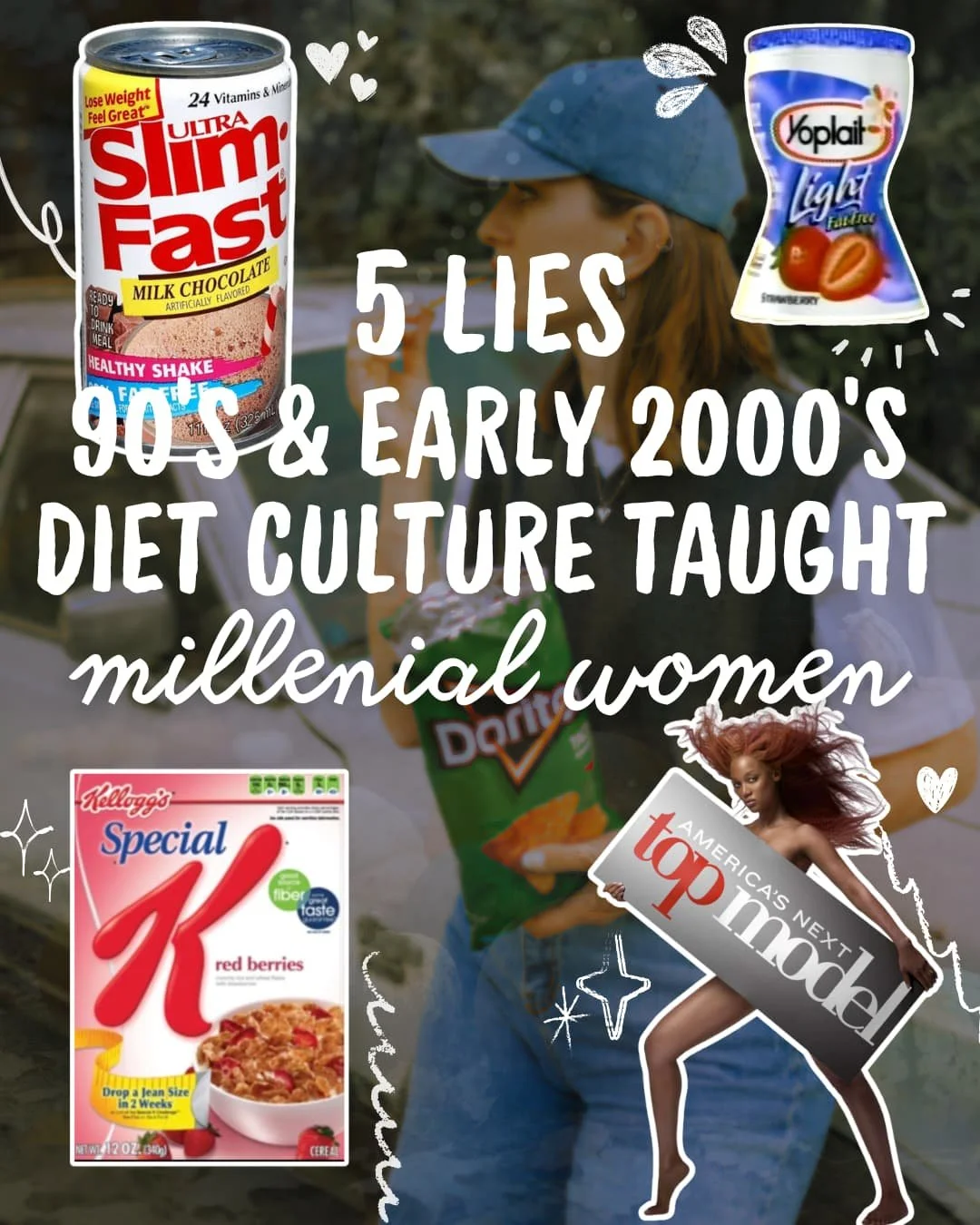
If you grew up in the ’90s or early 2000s (like I did!) diet culture was impossible to escape.
It was in the commercials we watched. It was splashed across magazine covers in the grocery store checkout line. It was reinforced by reality television, celebrity interviews, food packaging and conversations happening around the dinner table.
We watched women replace meals with a bowl of cereal and low-calorie shakes. We saw celebrities publicly criticized for gaining a few pounds. We learned to count points, choose 100-calorie snack packs, and look for the words fat-free on everything before allowing it to pass our lips.
And because these messages were so normal, many of us never recognized them as diet culture.
Now, decades later, many Millennial women are still struggling with guilt around food, fear of weight gain, and the persistent belief that they should be eating less.
Not because they lack willpower or want their entire day to be dictated by the number on the scale,
but because they (we) were taught some incredibly convincing lies.
So let’s separate diet-culture fiction from what we know to be true about nutrition, health and sustainable fat loss:
Lie #1: Your Body Is a Project That Always Needs Improvement
Growing up, we rarely saw women encouraged to simply live in, or appreciate, their bodies.
Instead, women’s bodies were treated like ongoing renovation projects.
There was always something to flatten, shrink, tone, tighten, conceal or correct. And every season brought a new opportunity to “get your body back,” prepare for bikini weather, or lose a few more pounds.
The underlying message was clear:
Your body is never good enough.
And while there is nothing inherently wrong with wanting to change your body or lose body fat, it is problematic to believe that changing your body is a lifelong responsibility, or that your appearance determines your worth.
You can pursue an aesthetic goal while respecting the body you live in.
You can want to create change without making your life, happiness or self-worth contingent upon achieving it.
Lie #2: Thinness = Health
The smaller the body, the healthier and more successful the person must be… or so we were taught.
Shows like America’s Next Top Model normalized the public criticism of already-thin women’s bodies. The Biggest Loser celebrated dramatic weight loss without ensuring health gain. Weight-loss advertisements used smaller bodies as proof that a product had improved someone’s life.
Thinness became a visual shorthand for health, discipline and moral goodness.
But body size alone cannot tell us how someone eats, whether they are physically active, how much muscle they have, how they sleep, what their blood work looks like or the status of their mental health.
A person can live in a small body while undereating, overexercising and experiencing serious physical or psychological consequences, while someone in a larger body can regularly participate in health-promoting behaviors.
Body composition may be one piece of someone’s health picture, but it is not the entire picture.
Losing body fat may improve health outcomes for some people, but that doesn’t mean thinner is always healthier or that the smallest body someone can maintain is their healthiest body.
Lie #3: Eating Less Is Always Better
Special K encouraged women to eat cereal for lunch and dinner. SlimFast told us to drink two shakes and a “sensible dinner.” Yoplait Light commercials idolized women eating 80 calories of yogurt while fantasizing about actual desserts.
The products changed, but the lesson remained the same:
The less you eat, the better you are.
Hunger became evidence of commitment and fullness was defined as failure.
Despite the fact that consistently eating too little can increase hunger, food preoccupation, fatigue and the likelihood of eventually overeating. It can also make it harder to train effectively, recover from exercise, preserve muscle and sustain your habits long enough to see meaningful results.
Sustainable fat loss is not about discovering the smallest amount of food you can tolerate.
Sustainable fat loss is about nourishing your body with balanced and satisfying meals while maintaining a manageable calorie deficit. Eating enough is not the antithesis of fat loss. In many cases, it’s what finally makes results possible.
Lie #4: Foods Are Either “Good” or “Bad”
The diet products of the ’90s and early 2000s didn’t just tell us to eat less, they also told us which foods made us good... or bad.
Fat-free cookies were good.
Regular cookies were bad.
A 100-calorie snack pack was controlled and virtuous.
Eating the same food from a full-sized package was indulgent and dangerous.
Foods with fewer Weight Watchers points were praised regardless of whether they were filling or nutritionally adequate. Meanwhile, foods containing fat, carbohydrates or more calories were treated with suspicion.
^^ this binary thinking turned everyday eating decisions into moral tests.
When we ate something “good” we felt disciplined. When we ate something “bad”, we felt guilty and believed we had “ruined” the day.
But food doesn’t possess moral value, and eating it does not determine the quality of your character.
When you stop treating foods as morally good or bad, you can evaluate them more practically:
Is this satisfying?
Does it support what my body needs right now?
What could I add to make this meal more balanced?
Removing morality from food often makes mindful choices easier because shame is no longer the driving force.
Lie #5: The Next Product Will Finally Fix You
Diet culture has always survived by convincing women that success is only one purchase away.
This cereal will help you drop a jean size…
This shake will make food easier to control…
The fat-free cookies/frozen meals/snack bars will finally give you the discipline you have been missing…
And when the product inevitably failed to create permanent results, the industry did not take responsibility,
YOU did.
You assumed you lacked willpower or failed to follow the rules closely enough. Then another diet, product or program arrived and offered you a new opportunity to try harder.
Products can sometimes be convenient. Meal-replacement shakes and packaged snacks are not automatically harmful, and using them does not mean you are participating in diet culture.
The issue is believing that a product will fix your relationship with food or remove the need to build sustainable habits.
Long-term change comes from learning how to nourish yourself adequately, navigate imperfect circumstances, respond to setbacks and make choices that fit your goals without allowing those goals to consume your life.
Why These Messages Still Affect Millennial Women
It’s easy to look back at old commercials and laugh at how ridiculous they seem,
but these messages didn’t disappear when the commercials stopped airing.
They became internal dialogue that sounds like:
“I shouldn’t need that much food.”
“A shake is probably better than an actual breakfast.”
“I was good all day until I ate dessert.”
“I need to make up for what I ate yesterday.”
“I know exactly what to do. I just need more willpower.”
“I’ll feel better about myself once I lose the weight.”
We didn’t wake up one day and decide these things. These stories were rehearsed in front of us for years when we were learning what food, health and womanhood were supposed to look like.
You Can Want Fat Loss Without Reliving Diet Culture
Rejecting the lies of ’90s and early-2000s diet culture doesn’t require you to reject every desire to change your body.
You are allowed to want to lose body fat.
You are also allowed to eat real meals, enjoy satisfying food and pursue your goals without recreating the restrictive environment in which many of us were raised.
The goal is not to follow a plan flawlessly.
It is to build a way of eating that supports the outcome you want while leaving room for work, family, celebrations, vacations and the rest of your life.
You do not need another product promising to fix you.
You need accurate information, unrelenting support and permission to stop measuring your success by how little you can eat.
You can absolutely want to lose body fat.
And you don’t have to relive ’90s and early-2000s diet culture to do it.